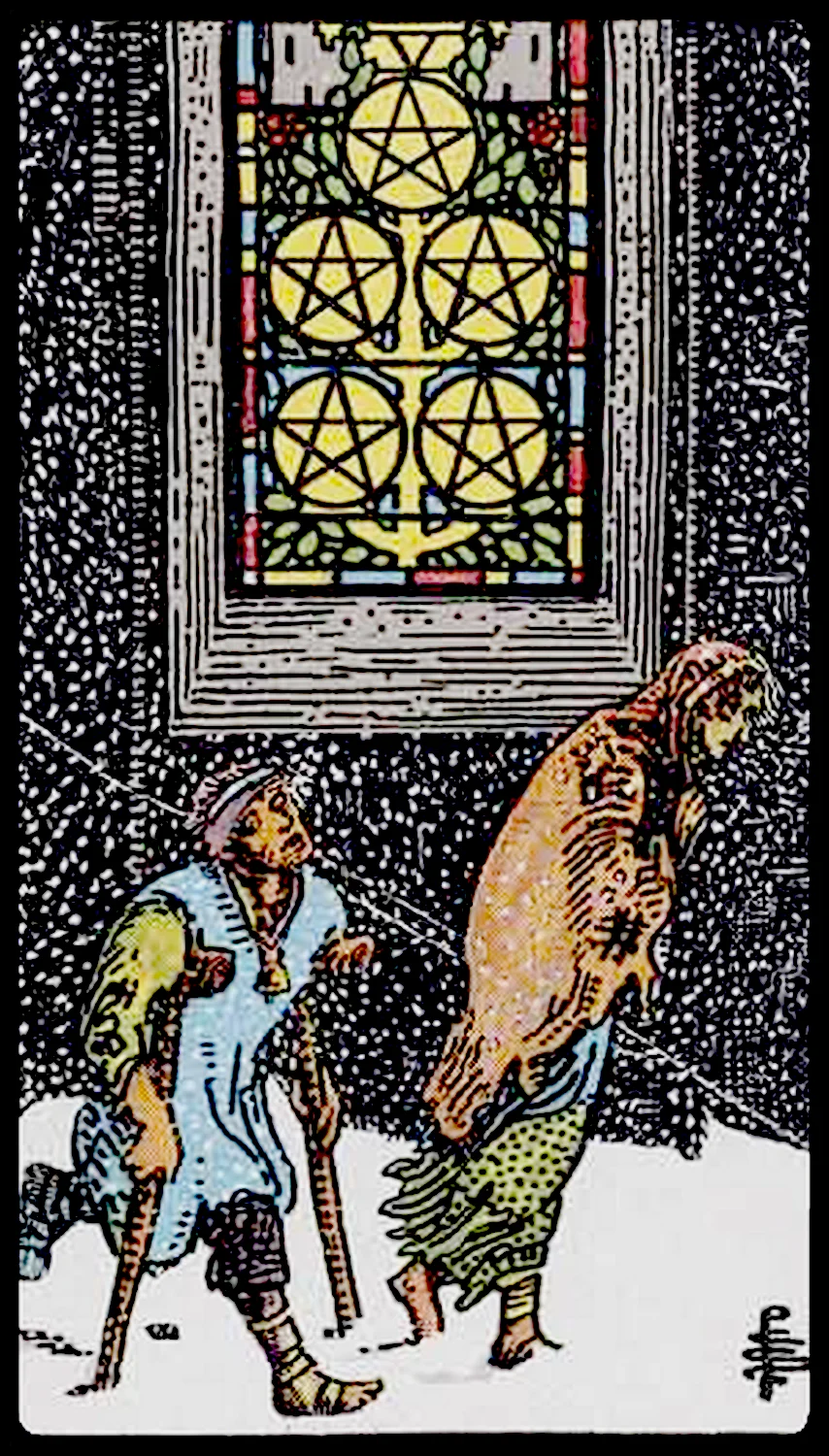
Five of Pentacles
Pentacles
How This Card Is Derived
Papus gives no separate description of this card. It is derived from his system: Pentacles is He final (ה), the realizing principle, the term that makes fact, acting in Assiah, the material world; the number 5 is He of the second series, the passive reaction to what was realized. The meaning below is that combination read out — the realizing principle, the term that makes fact taken at its 5th term — not a quotation from him.
Upright
He of He final: a passive term inside the world of matter, standing just after the pivot at four. Four fixed something material; five is what that fixed thing does back to the person holding it. So this is not loss by accident but loss by consequence — the estate that turns out to cost more than it returns, the body sending the bill for how it has been used, the settled arrangement that has quietly become want. Papus's material world is exact and unsentimental, and five is where it stops flattering.
Reversed
Inverted, the passive term stops being suffered and starts being answered. Reversed this reads as want acknowledged and therefore workable: the debt named, the help asked for, the arrangement broken off before it drains further. In a harder reading it is the same poverty refusing to be looked at — the pretence kept up, the accounts left unopened, want mistaken for bad luck rather than a term in a sequence that began at four.
Correspondences
- Suit
- Pentacles — He final (ה), Assiah, the material world
- Suit principle
- the realizing principle, the term that makes fact
- Number
- 5 — He of the second series
- Numeric role
- the passive reaction to what was realized
In a Spread
At the commencement, the matter starts from a material shortfall — read every later card as answering it. In opposition, five of pentacles is the cost the querent has not budgeted for. At equilibrium it drags: the situation is being held together by someone absorbing a loss. As the result, Papus's system is unambiguous — the matter concludes in the material world, and concludes short.